
Historic 62% Surpass of Target Efficiency Reached at Cape Town Container Terminal
Cape Town Container Terminal (CTCT) Sets New Efficiency Record
The Cape Town Container Terminal (CTCT) has achieved a remarkable resurgence in 2025/2026, setting new benchmarks for excellence in terminal operations. The terminal's performance in June 2025, in particular, stands out, as it handled a weekly volume of 19,931 twenty-foot equivalent units (TEUs), a 62% increase over its target and the highest weekly volume since March 2019.
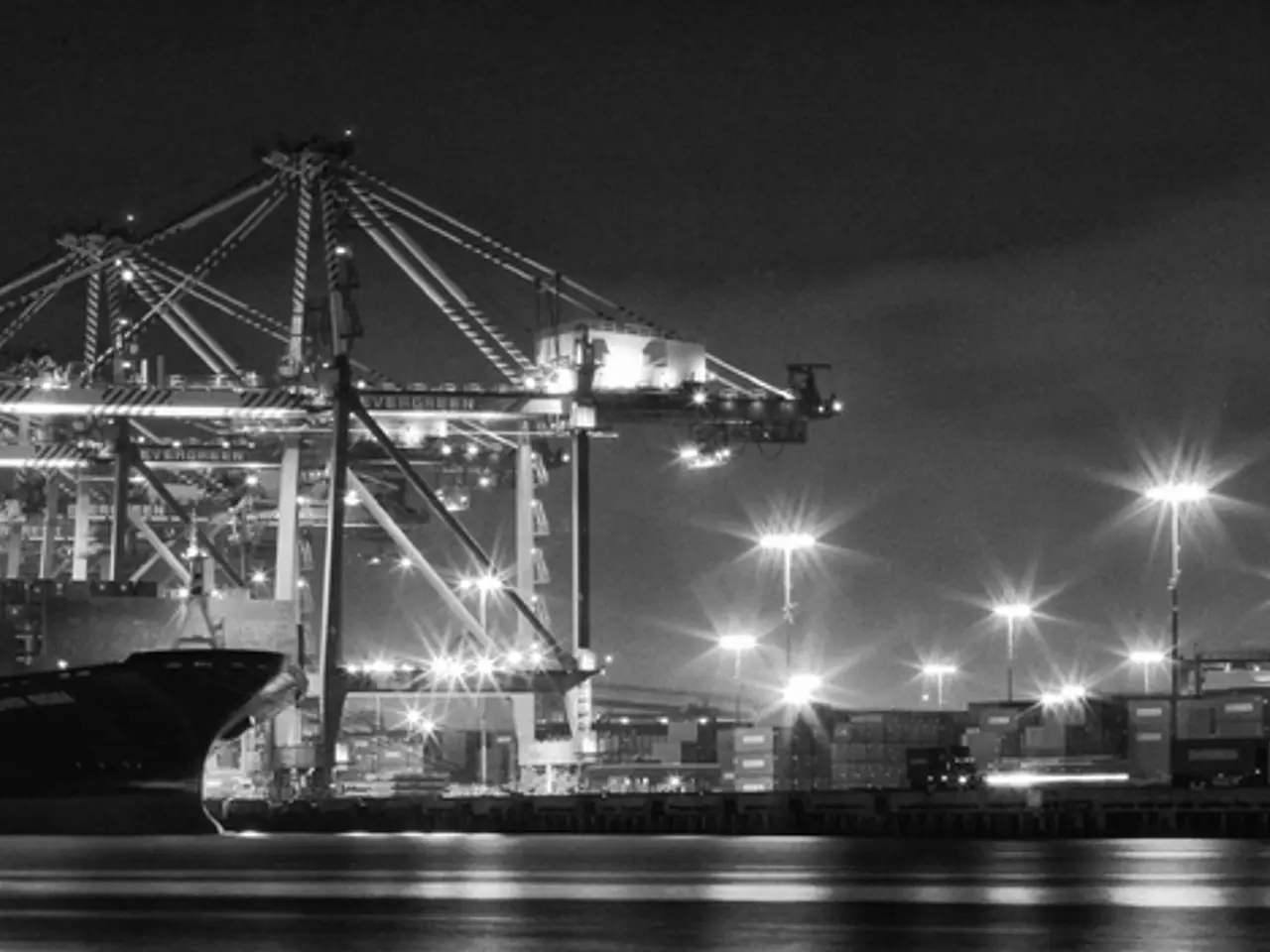
This impressive turnaround is the result of several key factors. First and foremost, Transnet Port Terminals (TPT) has made substantial investments in new equipment and infrastructure. In the 2024/2025 financial year, TPT allocated R3.4 billion for new container handling equipment, a 145% increase over the previous year. This investment has led to the delivery and commissioning of 7 new ship-to-shore cranes between March 2025 and May 2026, as well as the arrival of an additional 19 rubber-tired gantry cranes by mid-2026.
The terminal's expansion also includes capacity growth. TPT is upgrading the terminal’s capacity to handle 1.4 million TEUs, through improvements in truck staging facilities, process improvements, and plans to realign rail infrastructure. This capacity growth supports increased throughput and smoother landside operations.
Operational efficiency has also seen significant improvements. CTCT has set new operational records, such as container moves per shift and per hour, exceeding targets substantially. The terminal finished Q1 2025/2026 at 32% above its financial year target.
The strategic development of CTCT aligns with broader port development plans. The terminal expansion supports the Port of Durban as a hub port and the CT Multipurpose Terminal developing an agricultural hub. This integration improves port agility and supports growth in exports like agriculture-related goods.
Moreover, CTCT's focus on refrigerated (reefer) capacity and private sector participation aims to accommodate refrigerated goods more effectively. Plans to build additional reefer capacity and install new generators are part of this strategy to increase agility.
Terminal Manager, Noxolo Thabatha, stated that CTCT is in a much better position than it was last year. The terminal's leadership has emphasized workforce engagement, with daily performance targets communicated and ground support structures reinforced.
Despite challenges such as equipment reliability and weather, the focus is on maximizing resources and empowering the workforce to deliver. The terminal's ongoing investment in terminal infrastructure includes the acquisition of 18 new rubber-tyred gantry (RTG) cranes, nine of which have already been commissioned for operations.
In conclusion, CTCT’s resurgence is driven by large-scale investment in modern equipment, infrastructure and capacity upgrades, record-setting operational productivity, strategic regional integration, and enhanced refrigerated cargo handling capabilities—all contributing to improved efficiency and throughput in 2025/2026. The terminal's performance in June 2025 serves as a beacon of progress within Transnet Port Terminals (TPT).
The substantial investments in new equipment and infrastructure by Transnet Port Terminals (TPT) have significantly improved the efficiency of the Cape Town Container Terminal (CTCT), contributing to the growth of the local economy and the South African industry. The high monthly financial allocation for new container handling equipment has led to the delivery of new ship-to-shore cranes and rubber-tired gantry cranes, enhancing the terminal's capacity to handle cargo and energy-sensitive goods like refrigerated goods more effectively.




