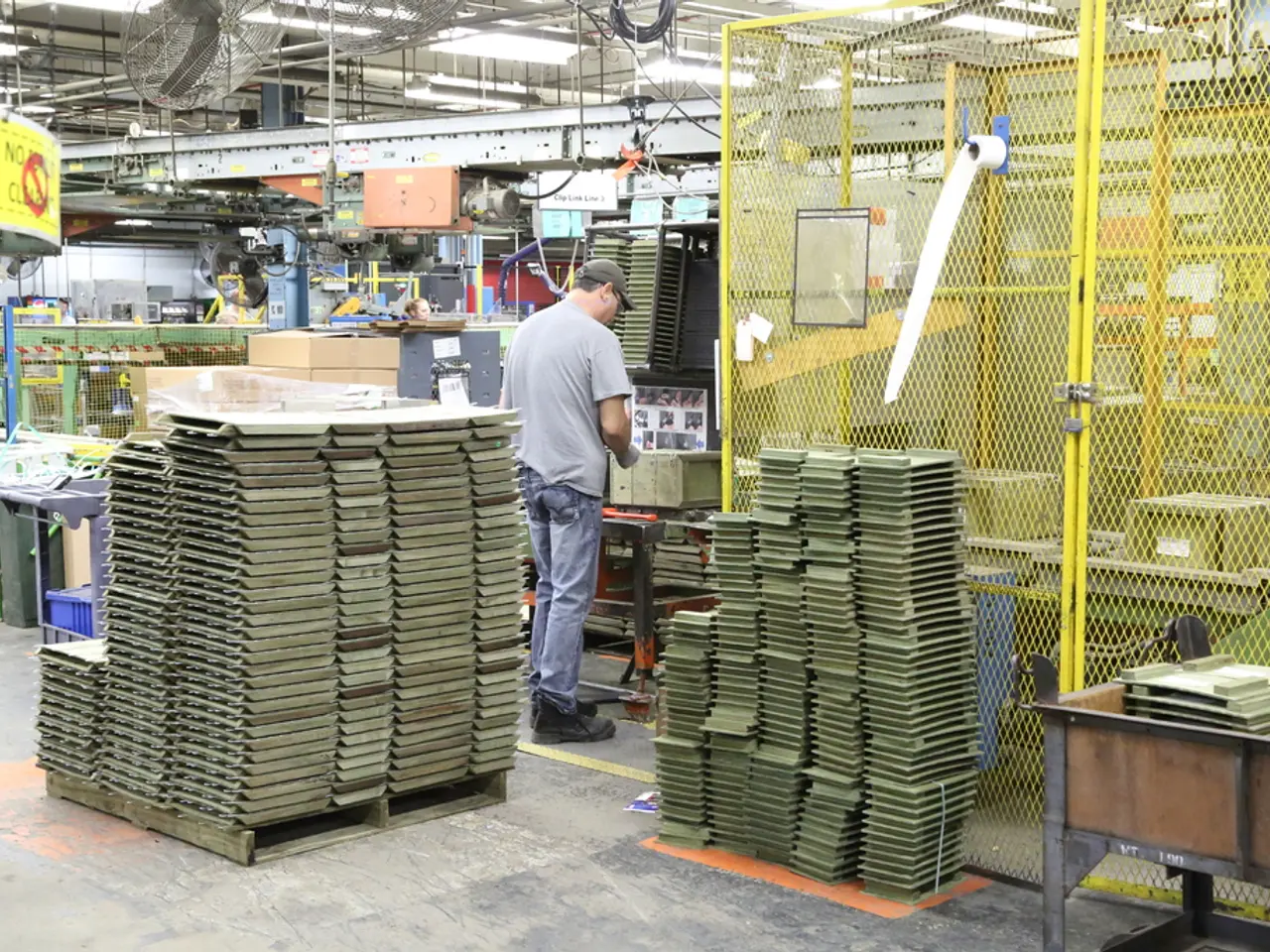
Factory production in Germany reaches lowest point since the onset of the Covid pandemic
In June 2025, Germany's industrial output took a significant hit, with a 1.9% month-on-month decline. This drop was more than analysts anticipated, as the initial boost from companies rushing shipments ahead of the tariffs wore off[1]. Simultaneously, exports to the U.S. declined by 2.1%, marking the lowest point since early 2022[1].
The new U.S. tariffs of 15% on most European goods, including German exports, have had a negative impact on Germany’s industrial output and economy. With approximately 10% of German exports going to the U.S., these tariffs weigh heavily on economic growth prospects[2][3]. Many German companies, particularly those in the automotive and machinery sectors, report immediate disadvantages and anticipate ongoing challenges, including political uncertainty and rising bureaucracy[2][3].
The tariffs compound existing economic pressures such as high energy costs and labor shortages. Germany’s economy slightly contracted in Q2 2025, with GDP falling by 0.1% quarter-on-quarter[4]. Surveys indicate a lack of business optimism, reduced investment plans, and fears of further tariff hikes among German firms[3].
The dire data could prompt a downward revision to the initial estimate showing that the German economy shrank slightly in the second quarter. However, plans to spend hundreds of billions of euros on infrastructure upgrades and rearmament had raised hopes that the worst might be over for Germany's economy[5].
Despite the challenges, industrial orders in Germany fell 1.0% month-on-month in June, following a drop of 0.8% in May[6]. On a positive note, German business morale rose to its highest level in July after seven straight increases[7]. Think tanks, including the respected DIW institute, have revised growth forecasts up for 2025 and 2026[8].
However, ING bank analyst Carsten Brzeski stated that industry remains stuck in a very long bottoming out[9]. Fixing the eurozone's traditional export powerhouse has been a key priority for Germany's new conservative Chancellor Friedrich Merz[10]. In light of the challenges, calls for large investment projects in Germany to counteract trade setbacks have intensified[4][5].
In conclusion, the new tariffs have caused a sharp fall in industrial output after a temporary pre-tariff surge[1], led to declining exports to the U.S., disrupting a key market accounting for 10% of German exports[1][2], increased uncertainty and costs for medium-sized “Mittelstand” companies[2], contributed to an economic contraction in early 2025 amid other structural challenges[3][4], and resulted in calls for large investment projects in Germany to counteract trade setbacks, although the overall outlook remains uncertain[4][5].
References:
- Reuters (2025). German industrial output falls more than expected in June. https://www.reuters.com/business/economy/german-industrial-output-falls-more-expected-june-2025-07-15/
- Bloomberg (2025). German Companies Warn of More Disadvantages as U.S. Tariffs Loom. https://www.bloomberg.com/news/articles/2025-06-01/german-companies-warn-of-more-disadvantages-as-u-s-tariffs-loom
- Financial Times (2025). German business morale rises to highest level in July. https://www.ft.com/content/a6292e4a-3e1f-40b9-8b7e-6f5115f1b20a
- BBC News (2025). Germany's economy shrinks slightly in second quarter. https://www.bbc.com/news/business-58840930
- Deutsche Welle (2025). Germany's economic outlook for 2025 and 2026 revised upwards. https://www.dw.com/en/germanys-economic-outlook-for-2025-and-2026-revised-upwards/a-57442005
- Destatis (2025). Industrial orders in Germany fall 1.0 percent month-on-month in June. https://www.destatis.de/EN/PressService/PressReleases/pr_detail.html?ObjPath=/Pressemitteilungen/2025/07/15_Industrial_Orders_in_Germany_Fell_1.0_Percent_Month-on-Month_in_June.html
- Financial Times (2025). German business morale rises to highest level in July. https://www.ft.com/content/a6292e4a-3e1f-40b9-8b7e-6f5115f1b20a
- Deutsche Welle (2025). Germany's economic outlook for 2025 and 2026 revised upwards. https://www.dw.com/en/germanys-economic-outlook-for-2025-and-2026-revised-upwards/a-57442005
- Financial Times (2025). German business morale rises to highest level in July. https://www.ft.com/content/a6292e4a-3e1f-40b9-8b7e-6f5115f1b20a
- Reuters (2025). Merz's conservative party wins German election, setting up battle with leftist coalition. https://www.reuters.com/world/europe/merzs-conservative-party-wins-german-election-setting-battle-leftist-coalition-2025-09-26/
The new U.S. tariffs have caused a significant dip in Germany's finance sector, with the potential to affect overall business performance. Political leaders are now debating the implementation of large investment projects to counteract the tariff's impacts on major export industries like automotive and machinery.
Rising bureaucracy and political uncertainty loom over medium-sized companies, posing a threat to Germany's traditionally strong export powerhouse, and potentially affecting general-news topics related to trade relations and economic stability.