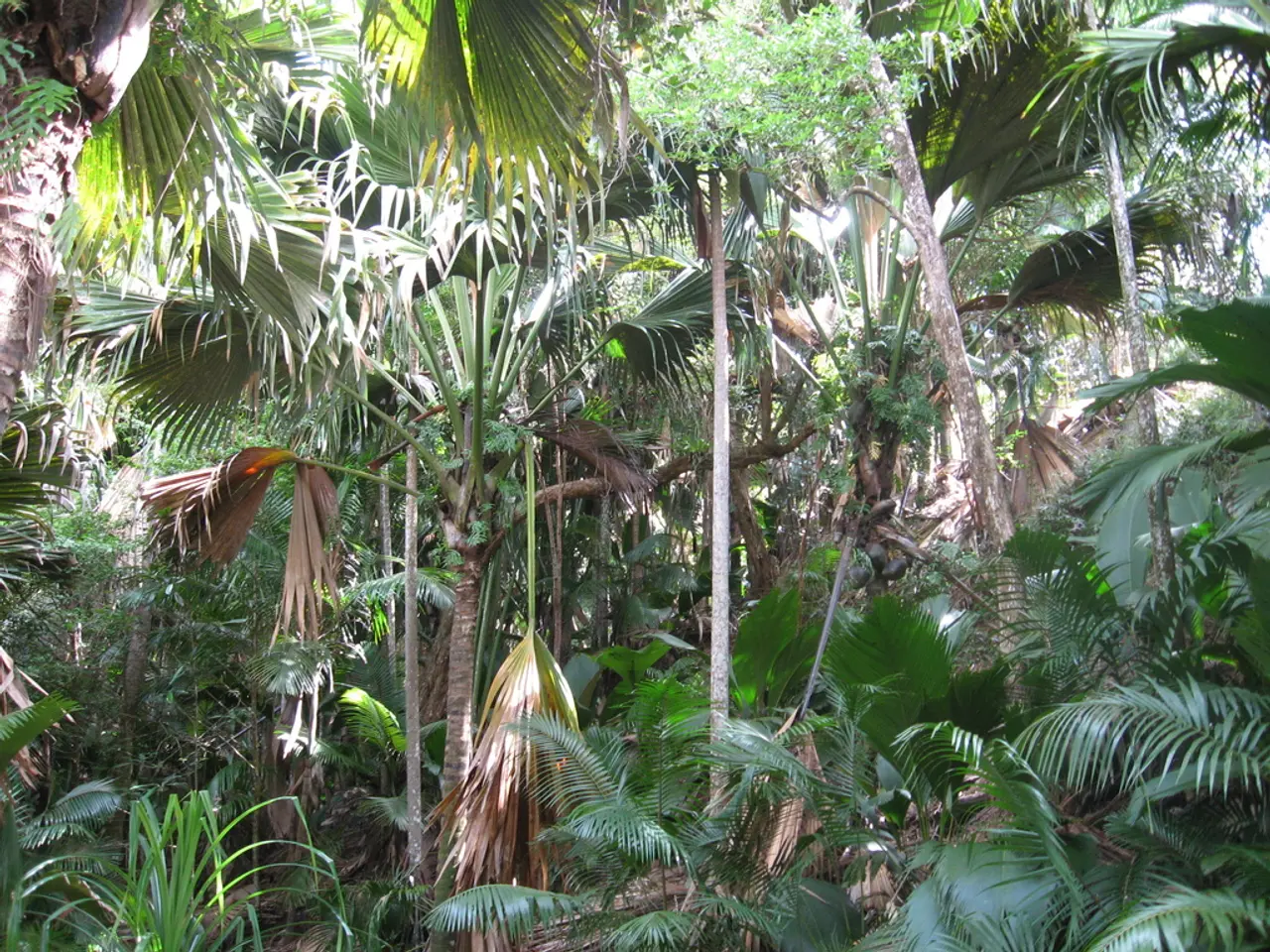
Carbon Capture Strategy Through Agroforestry Methods in Various Climatic Conditions
Agroforestry, a farming method that combines trees and shrubs with crops or livestock, is gaining traction as a sustainable and beneficial practice for both farmers and the environment. By integrating trees into agricultural landscapes, agroforestry offers numerous advantages, from boosting biodiversity and improving soil health to reducing the need for irrigation and providing cleaner air.
One of the key benefits of agroforestry is its ability to create a resilient ecosystem. Mixed planting in agroforestry attracts various pollinators, vital for plant health, and helps control pests naturally by attracting birds and insects. Trees in agroforestry also help retain water in the soil, reducing the need for irrigation, and their leaves and branches, when they decompose, enrich the soil, boosting fertility and encouraging beneficial microbes.
Agroforestry is not just about trees, though. Cover crops in agroforestry systems protect the soil from erosion and add nutrients when they decompose. Proper spacing between trees, ideally 10-15 feet apart, avoids competition for resources, making maintenance easier.
In temperate climates, agroforestry plays a crucial role in carbon sequestration. Techniques such as silvopasture, alley cropping, and integrating perennial woody plants with crops or grazing systems are used to maximize carbon storage both above and below ground. Trees in agroforestry systems increase soil carbon by contributing woody biomass and leaf litter, improving soil structure and organic matter content. Well-managed trees in silvopastoral systems can grow faster than in monoculture forests, sequestering more carbon aboveground.
The benefits of agroforestry for carbon sequestration in temperate regions are significant. Enhanced soil organic carbon stocks, increased carbon storage in biomass, climate change mitigation, improved resilience and productivity, and reduced need for external inputs are just a few of the advantages. Agroforestry provides a cost-effective nature-based solution to offset CO2 emissions, with global mitigation potentials estimated between 0.12 to 0.31 Pg C per year.
Agroforestry is more than just a farming technique; it's a way to create a balanced ecosystem on farms and allow for food production while caring for the environment. By attracting various animals and insects, agroforestry helps keep the ecosystem stable. More trees in agroforestry mean cleaner air for us to breathe, as trees absorb carbon dioxide from the air and store it, and their roots dig deep into the soil, breaking up compacted layers and creating pathways for air and water.
In conclusion, agroforestry is a versatile and beneficial practice for farmers and the environment. By adopting agroforestry, farmers can nurture the land, leading to better crop production over time, while also contributing to carbon sequestration, biodiversity, and the overall health of our planet.
- The integration of trees in agroforestry not only boosts biodiversity and improves soil health, but also helps in carbon sequestration, contributing towards climate-change mitigation.
- Agroforestry as a practice offers numerous advantages, ranging from renewable energy (carbon sequestration) to environmental-science (biodiversity enhancement) and even finance (cost-effective CO2 offsetting solutions).
- Trees in agroforestry systems, through their decomposed leaves and branches, enrich soil, providing quality for food crops by improving fertility and encouraging beneficial microbes.
- Beyond just trees, cover crops in agroforestry systems contribute to the quality of soil by protecting it from erosion and adding nutrients when they decompose.
- Agroforestry, in the industry of renewable energy, stands as a sustainable method, using techniques like silvopasture and alley cropping to harness renewable energy in the form of carbon sequestration.